Americans Aren’t Done With RVing. They May Just Be Done Buying the RV First.

New data reveals a growing disconnect between demand for outdoor experiences and the economics of buying a new RV. For dealers and manufacturers, rental may be the missing bridge between interest and ownership.
Camping demand remains strong while new RV shipments decline. See why RV rentals, dealer rental fleets and professional RV rental operations could become a critical customer-acquisition and revenue strategy.
For years, the RV industry's primary path to the consumer was straightforward: generate interest in the lifestyle, bring that customer to a dealership, and sell an RV.
The latest market data suggests that sequence may need another step.
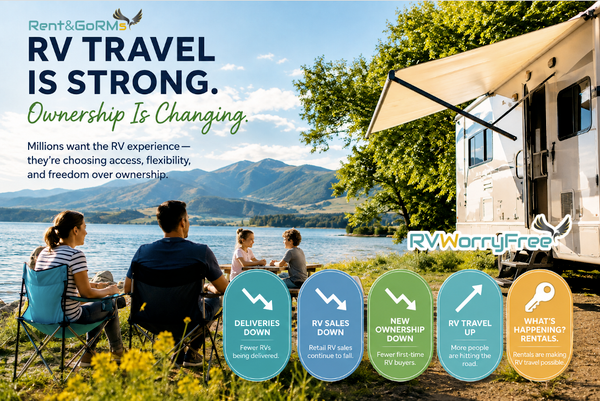
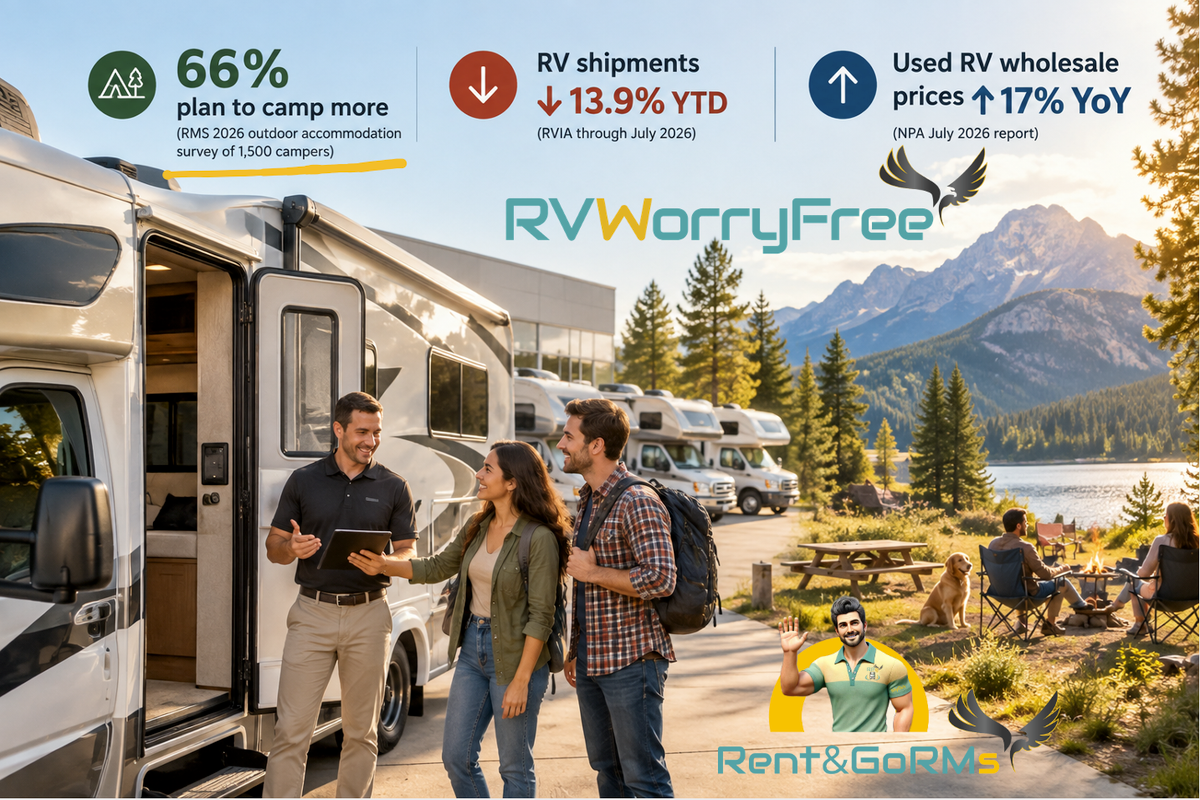
Consumers are still interested in camping and outdoor travel. In fact, RMS's newly released 2026 State of Outdoor Accommodation Report found that 66% of surveyed campers plan to camp more in the coming year, an eight-percentage-point increase from last year. The study surveyed 1,500 campers across the United States, United Kingdom, Australia and New Zealand.
At the same time, the new-RV market is moving in the opposite direction. The RV Industry Association reported 19,948 wholesale RV shipments in July, down 11.9% from July 2025. Through the first seven months of 2026, shipments were down 13.9%. Motorhome shipments alone declined 25.6% in July.
Those numbers do not tell us that consumers are finished with RVing.
They may be telling us something more important: wanting the RV experience and being ready to purchase an RV are increasingly two different decisions.
The Demand Problem May Not Be Where We Think It Is
The outdoor hospitality data makes it difficult to argue that consumers have simply lost interest in camping.
Beyond the 66% who expect to camp more, 86% of RMS respondents identified as lifelong or returning campers. Digital discovery is also expanding: 64% now use online search to discover campsites, overtaking word of mouth at 60% for the first time in RMS's annual research.
Consumers still want the experience.
What has become more difficult is the ownership transaction itself. Financing costs, household budgets, insurance, storage, maintenance and economic uncertainty all affect the decision to purchase a recreational asset.
That distinction matters enormously for an RV dealership owner or manufacturer.
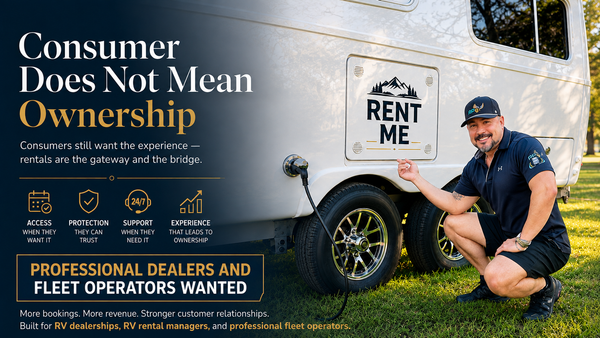
If a consumer wants to camp but is not yet prepared to spend tens of thousands of dollars purchasing an RV, the industry has two choices: lose that transaction or give the consumer another way into the lifestyle.
Professional RV rental provides that second path.
Rental Can Fill the Gap Between Interest and Ownership
Rental should not be viewed simply as an alternative to selling an RV.
It can be the transaction that occurs before the sale.
Consider a consumer interested in RVing but uncertain about ownership. They may not know whether they want a Class B, Class C or travel trailer. They may not know how frequently their family will actually travel. They may be concerned about towing, storage or maintenance.
Traditionally, the industry has asked that consumer to answer those questions before making a very large purchase.
Rental reverses the process.
The customer can experience the product first, understand how their family uses it, discover which floorplan or RV type fits them, and make a future purchase decision with considerably more confidence.
For an RV dealership manager or RV dealership owner, that means an RV rental fleet can serve two purposes simultaneously: produce revenue today and create qualified ownership prospects for tomorrow.
That is a fundamentally different way to think about an RV dealership rental department.
The Used Market Provides Another Important Signal
There is another piece of current market data that deserves attention.
National Powersport Auctions reported that RV and camper average wholesale prices were 17% higher year over year in its September report covering July activity, despite the normal seasonal cooling occurring month to month. NPA described the pre-owned segment as continuing to show strength.
That does not prove consumers are moving from ownership to rental, and we should not pretend that it does.
But it does tell dealers something valuable: usable RV assets still have economic value even while new-unit shipments are struggling.
That creates an interesting lifecycle opportunity.
A dealer does not necessarily have to choose between selling an RV and renting an RV.
The same asset can potentially move through multiple revenue stages:
Acquire → Rent → Generate ancillary/service revenue → Introduce consumers to RVing → Maintain → Eventually sell as pre-owned inventory.
For an RV fleet manager, that is an asset-utilization strategy. For the dealership, it creates the possibility of generating revenue before disposition rather than relying exclusively on the eventual retail sale.
Stop Measuring an RV Only by the Day It Sells
Dealership economics have traditionally centered heavily on inventory turn.
How quickly did the unit sell? What was the gross? How long did it sit on the lot?
Those remain important questions.
But rental introduces another measurement:
What did the asset earn while we owned it?
An RV that sits for 120 days waiting for a retail buyer is inventory.
An RV that completes rental bookings during part of those 120 days can become a revenue-producing asset.
That revenue can include the base rental rate, delivery, mileage, generator usage, pet fees, protection products, insurance or damage-waiver products, accessories and service opportunities.
This is where RV fleet management and traditional dealership inventory management begin to overlap.
For professional RV rental companies, the objective is already familiar: maximize fleet utilization and revenue per available unit.
For dealerships, that mindset represents a larger shift.
Rental Also Creates Something Dealers Spend Heavily to Acquire: Customers
Dealers spend significant amounts of money generating leads.
Search advertising, social advertising, RV shows, events, third-party leads and traditional marketing all exist for essentially one reason: put a potential buyer in front of the product.
Rental can accomplish that while generating revenue.
A renter does not spend 20 minutes walking through an RV at a show.
They may spend three, four or seven days living in it.
They sleep in it. Cook in it. Drive it. Camp in it. Learn what they like and what they would change.
That is an unusually deep product demonstration.
Not every renter will become an owner, and any claim that rentals automatically create buyers would exceed the available evidence.
But strategically, the renter can become one of the dealership's most educated future prospects.
That is why RV rental management should increasingly be considered part of customer acquisition, not simply another dealership department.
Digital Expectations Are Rising at the Same Time
The opportunity comes with an operational requirement.
Consumers accustomed to booking hotels, rental cars and vacation homes digitally are bringing those expectations into outdoor hospitality.
RMS found that nearly 85% of campers are more likely to book when they can select their exact campsite in advance. Fourteen percent are already using AI tools while researching camping trips.
That behavior matters for RV rental operations as well.
If a dealership launches rentals but requires consumers to call during business hours, exchange PDFs, wait for manual quotes and navigate disconnected payment and check-in processes, it has created a rental department without creating a modern rental experience.
Professional RV rental software and RV rental management software therefore become part of the strategy rather than merely back-office technology.
The customer should be able to discover inventory, see availability, understand pricing, select protection and insurance options, complete agreements, make payments, communicate with the operator and prepare for the trip with as little friction as practical.
For the RV rental manager, automation also changes the economics of shorter bookings because each reservation requires less manual labor.
Manufacturers Have a Stake in This Too
This opportunity extends beyond individual dealers.
Manufacturers traditionally depend on dealers to place inventory in front of potential buyers. But if fewer consumers are prepared to move directly from interest to ownership, manufacturers need additional ways to put consumers inside their products.
A manufacturer-backed rental strategy could create exactly that.
Designated rental inventory placed within professional dealership fleets could expose thousands of consumers to specific brands and floorplans while generating revenue for participating dealers.
Rental then becomes more than a fleet business.
It becomes product sampling at scale.
Automotive manufacturers have understood versions of this concept for decades through leasing, rental fleets, demonstrator programs and subscription experiments. The RV industry does not need to copy those models exactly, but the underlying principle is relevant: access can introduce a consumer to a product before ownership.
The Opportunity Goes Beyond RVs
The same economic tension exists across other motorized recreational assets.
Boats, motorcycles, side-by-sides, ATVs, personal watercraft, trailers and specialty vehicles can require substantial upfront capital while being used intermittently.
That creates a broader ownership-versus-access question.
For professional fleet operators, the opportunity is to make temporary access easy enough that consumers can participate without making an immediate ownership commitment.
For manufacturers and dealers, the opportunity is to make sure temporary access does not become a dead end—but instead becomes part of a customer lifecycle.
Rent. Experience. Return. Rent again. Eventually buy—or remain a profitable renter.
Either outcome can create economic value.
The Industry May Need to Stop Treating Rental as the Alternative to Retail
The most important conclusion from the current data is not that rental will replace ownership.
It won't.
Nor does the available evidence prove that declining RV shipments are being caused by consumers choosing rental instead.
What the evidence does show is a meaningful disconnect:
Camping demand remains strong. New-RV shipments are down. Pre-owned RV values remain comparatively resilient. Consumers increasingly expect digital, low-friction access to outdoor experiences.
That creates room between wanting the lifestyle and purchasing the asset.
Rental can occupy that space.
For an RV rental company owner, that means opportunity.
For an RV fleet manager, it means utilization.
For an RV dealership owner, it can mean rental revenue, service revenue and another source of future buyers.
For a manufacturer, it can mean getting more consumers inside the product.
And for the consumer, it means something even simpler:
They do not have to decide today whether they want to own an RV for the next ten years.
They only have to decide whether they want to use one this weekend.
The future of RV ownership may begin with access.