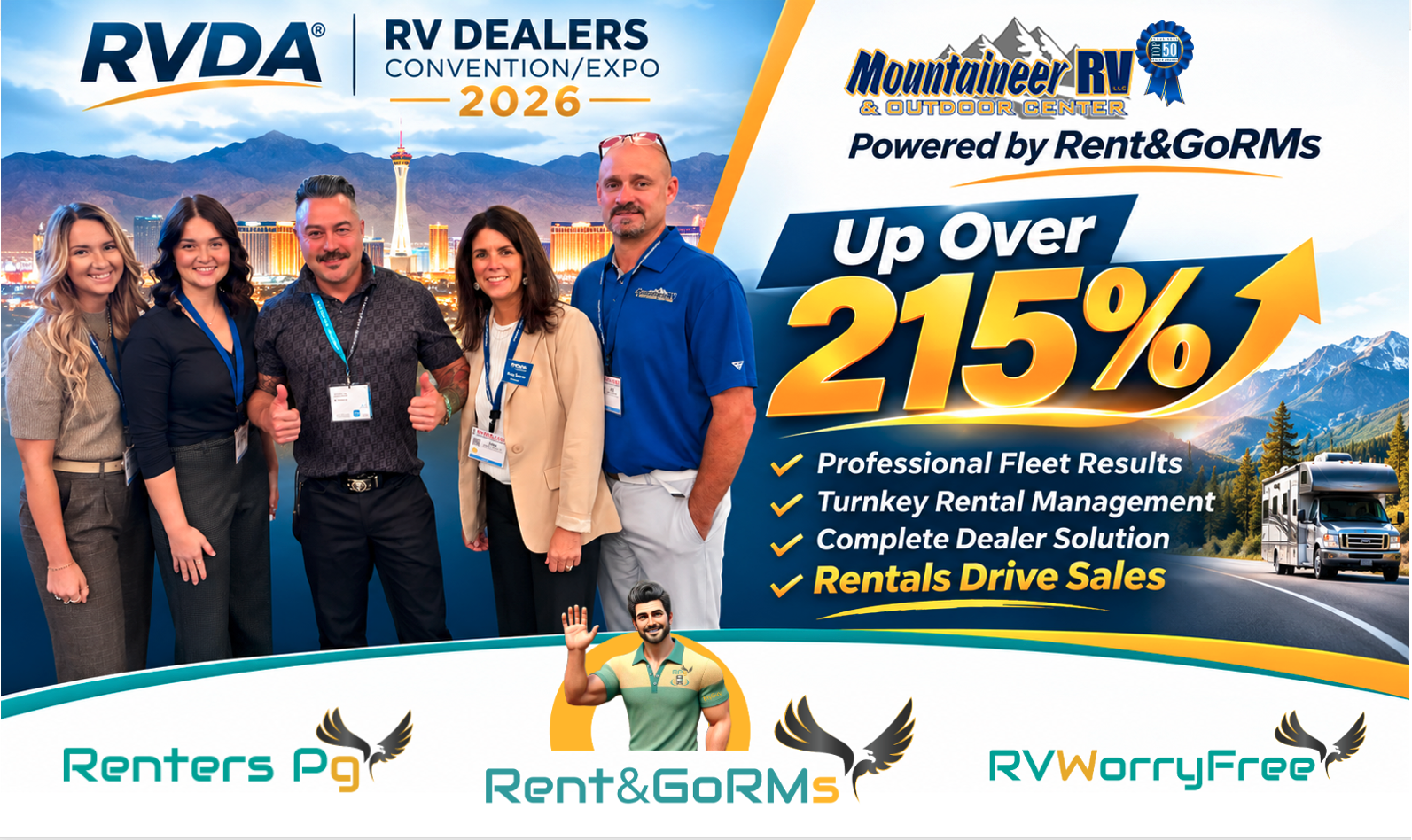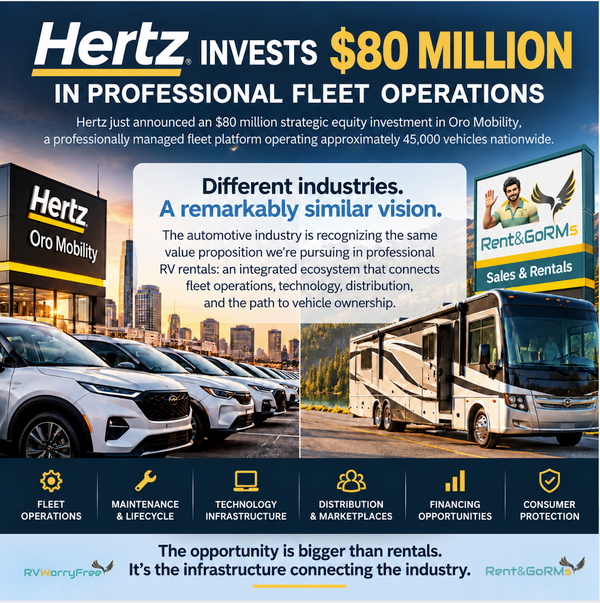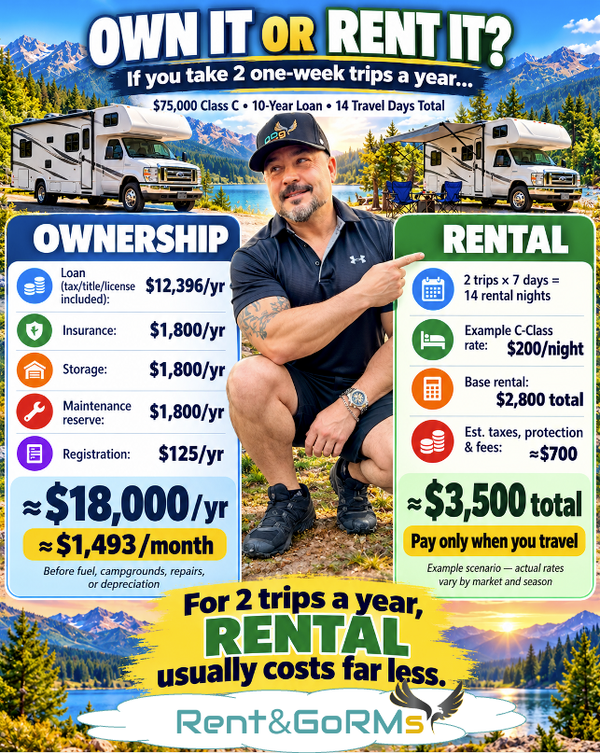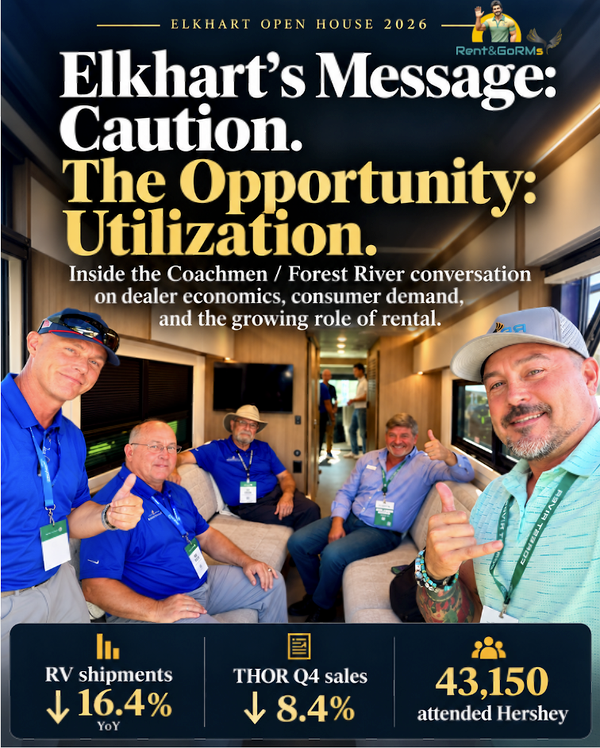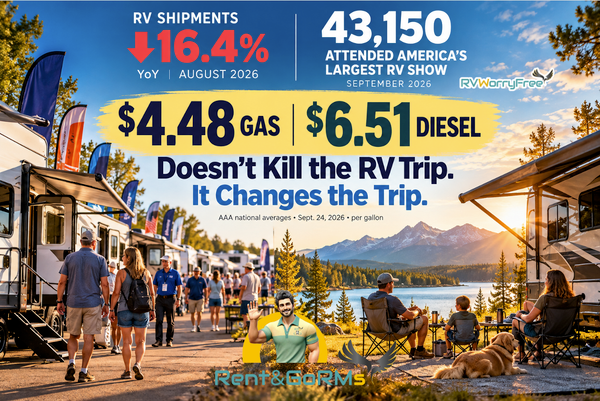
~One Dealer Out of Business ~One Dealer up 215% RVDA 2026 Confirmed It: Rentals Are the Revenue and Customer Acquisition Strategy RV Dealers Are No-Longer Ignoring.

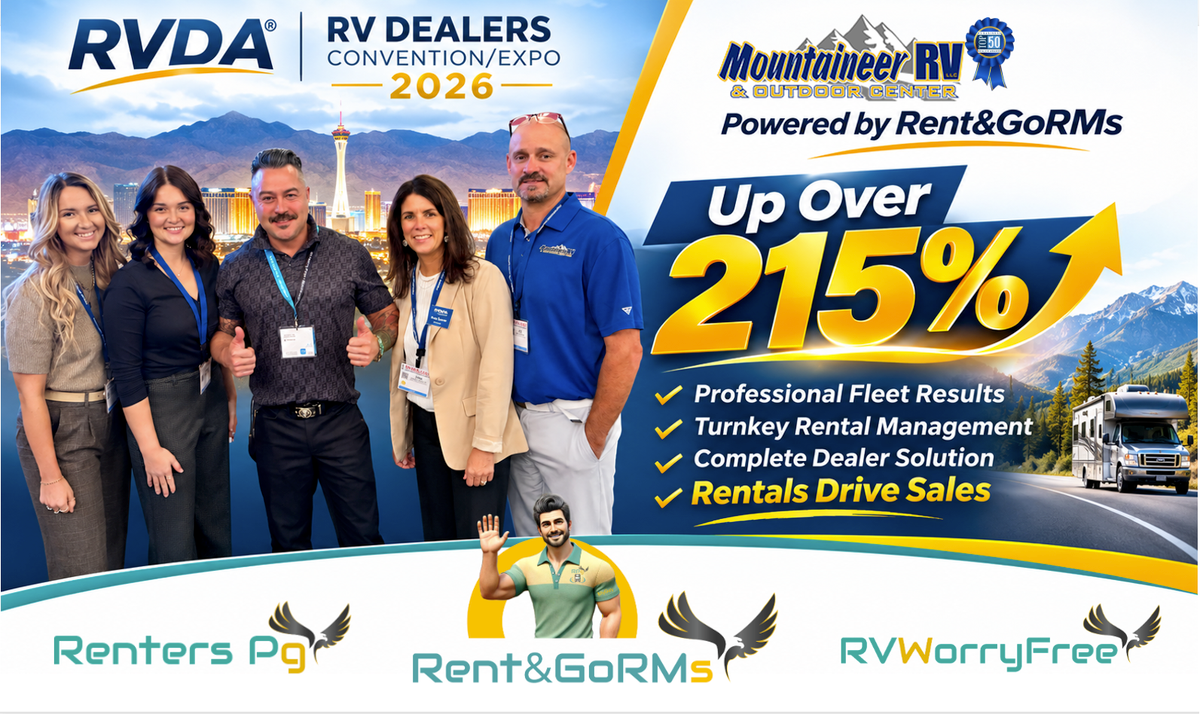
RV sales are under pressure. Consumer interest in RV travel remains strong. And after a week of firsthand conversations with dealership owners and industry leaders in Las Vegas, one thing became clear: the industry needs a better way to turn travelers into customers.
By Eo Sparks | Founder, Renters Protection Group (RPg) & Rent&GoRMs
Rentals Drive Sales. RV Buyers Rent First.
The 2026 RV Dealers Convention/Expo in Las Vegas delivered a message that went well beyond the seminars, exhibits, and industry forecasts.
Dealers are looking for answers.
New RV sales are under pressure. Manufacturers are adjusting production to softer demand. Dealership owners are evaluating every department for opportunities to improve revenue, profitability, and customer acquisition.
Yet millions of Americans still want to experience the RV lifestyle.
That disconnect may represent one of the most important opportunities facing the RV industry today.
At Renters Protection Group (RPg), we spent the week at RVDA demonstrating Rent&GoRMs, our dealer-focused RV rental management platform, and speaking directly with dealership owners, rental managers, industry partners, and professionals evaluating new rental operations.
The response reinforced what we've believed for years:
RV rentals should not be treated as a separate business disconnected from RV sales. They should be a strategic extension of the dealership itself.
And for the first time, we've brought together the technology and operating infrastructure designed to make that practical for professional rental fleets.
The Numbers Tell the Story: Sales Are Slowing, but RV Travel Isn't Disappearing
According to the RV Industry Association, 2026 wholesale RV shipments are projected to finish near 290,000 units, approximately 15.3% below 2025.
New RV registrations declined 15.9% year over year through August, according to Statistical Surveys data reported in Camping World's November SEC filing.
More recently, RVBusiness reported that dealership sales department performance in Lightspeed's October 2026 reporting sample fell 10.2% from the prior year.
These figures reflect real pressure on dealerships, manufacturers, and the businesses supporting them.
But consider what is happening on the travel side.
The RV Industry Association's November travel survey estimates that 11.4 million Americans intend to travel by RV over Thanksgiving and another 11.2 million over Christmas.
Meanwhile, AAA's Thanksgiving forecast, highlighted this week by Camper Report, projects nearly 73 million Americans traveling by automobile over the holiday.
And perhaps most important for dealerships, RVIA reported earlier this fall that more than 9.4 million Americans who do not own an RV planned to rent or borrow one during the fall travel season.
These are travel intentions, not confirmed rental bookings. Nevertheless, they demonstrate a significant audience interested in experiencing RVs without immediately purchasing one.
The opportunity isn't simply to sell more RVs to existing buyers. It's to create more future buyers.
What We Heard Firsthand at RVDA 2026
Industry reports provide statistics.
But conversations with the people operating dealerships provide something equally valuable: an understanding of what is preventing them from growing.
Throughout RVDA, we repeatedly heard variations of the same challenges.
Some dealerships had operated rental departments before COVID and never restarted them. Others had considered entering the rental market but found the operational requirements overwhelming.
Many were interested in rental revenue but were understandably hesitant to introduce another complicated business process into an already busy dealership.
The recurring frustrations were remarkably consistent:
- Outdated or fragmented rental management software.
- Dependence on third-party marketplaces to generate and process bookings.
- Slow reservation workflows, manual emails, and disconnected customer communications.
- Limited automated payments, deposits, and reservation management.
- Inadequate access to integrated renter protection products.
- Inconsistent check-out and check-in procedures.
- Missing timestamped vehicle photographs and documented condition reports.
- Damage disputes without standardized supporting records.
- No efficient way to manage rental maintenance, consignment vehicles, and fleet utilization.
- Little connection between rental customers and dealership sales opportunities.
These weren't objections to the concept of RV rentals.
They were objections to the way RV rentals had traditionally been managed.
And that distinction matters.
The dealers we spoke with weren't asking for another marketplace or another collection of disconnected software subscriptions.
They wanted a complete operational solution.
When we demonstrated what Rent&GoRMs brings together, the response was overwhelmingly positive.
For many, the technology and operational gaps that had kept them out of rentals were the exact problems we had set out to solve.
Rentals Are More Than Another Revenue Stream
Let's look beyond the immediate rental transaction.
A traditional dealership depends heavily on customers who have already decided to purchase an RV.
A rental department reaches consumers much earlier.
A family considering RV ownership may be hesitant to spend $80,000, $120,000, or more on a vehicle they have never experienced.
But that same family may be willing to spend a few thousand dollars on a weeklong RV vacation.
That rental introduces them to the lifestyle, the vehicle, and the dealership.
A properly managed rental operation can create several opportunities from a single customer relationship:
1. Rental revenue. The dealership earns income from fleet utilization instead of depending exclusively on vehicle sales.
2. Additional products and services. Eligible protection products, roadside services, delivery, setup, accessories, and other offerings can expand revenue per rental.
3. Parts and service. Rental fleets create recurring maintenance and repair activity that can support dealership fixed operations.
4. Qualified sales prospects. Renters gain practical experience with an RV, providing the dealership with valuable insight into their interests, preferences, and purchasing timeline.
5. Future vehicle sales. A satisfied renter may return to purchase an RV from the dealership that introduced them to the lifestyle.
6. Fleet remarketing and certified pre-owned opportunities. Properly documented rental units can create structured paths toward resale, subject to vehicle condition, applicable standards, and any manufacturer program requirements.
This is how rentals become more than a department.
They become a customer acquisition strategy.
A dealership can generate revenue while consumers discover whether RV ownership is right for them.
Instead of waiting for the customer to become a buyer, the dealership helps create the buyer.
The Peer-to-Peer Market Is Changing. Professional Fleets Have an Opening.
For years, peer-to-peer rental platforms helped introduce consumers to RV rentals.
They expanded awareness and helped develop consumer familiarity with booking RVs online.
But the market is evolving.
In May 2026, RVBusiness reported that Outdoorsy had reduced its RV rental inventory by approximately 45% over the preceding 18 months as part of a deliberate strategy to improve quality and reliability.
That doesn't mean peer-to-peer RV rentals are disappearing across every platform.
It does, however, highlight a fundamental issue that professional rental operators are positioned to address: consistency.
Consumers want reliable vehicles, transparent rental terms, straightforward booking, dependable support, and confidence that someone will be available when something goes wrong.
Professional RV rental fleets can deliver those advantages through experienced personnel, established service departments, documented maintenance procedures, and standardized customer experiences.
The RV Rental Association has specifically identified the technical knowledge, maintenance capabilities, and customer support of professional rental dealers as important competitive advantages.
This represents a potential shift in the competitive landscape.
Dealers and professional fleet operators have an opportunity to compete on operational quality—not just available inventory or rental price.
And with the right technology, they can do it under their own brands while maintaining access to outside distribution channels when those relationships make economic sense.
The Technology Barrier Has Been Removed: Introducing Rent&GoRMs
This is where our experience at RVDA became especially meaningful.
For years, many dealerships had the inventory, service capabilities, and customer relationships necessary to operate a rental department.
What they lacked was an integrated operating system designed around the actual needs of a professional fleet.
Rent&GoRMs was built to address that problem.
Rather than forcing dealers to operate through a consumer marketplace or piece together disconnected applications, Rent&GoRMs provides a comprehensive rental management environment designed for dealership and professional fleet operations.
The platform brings together:
- Direct online bookings: Branded booking capabilities that integrate into the dealership's own website.
- Fleet and reservation management: Vehicle availability, rental calendars, pricing, inventory, and booking workflows.
- Automated customer communications: Reservation confirmations, payment notifications, and operational communications.
- Integrated payment management: Payment collection, deposit workflows, and financial tracking.
- Renter verification and documentation: Identity verification workflows, rental agreements, and electronic signatures.
- Digital check-out and check-in: Vehicle inspections, condition records, photographs, mileage, fuel, and generator documentation.
- Protection products: Access to applicable RVWorryFree offerings and RPg rental protection programs, including Rental Vehicle Service Contracts.
- Fleet maintenance management: Vehicle service tracking, maintenance documentation, and operating records.
- Consignment management: Tools supporting privately owned vehicles, owner relationships, and rental revenue allocation.
- Business reporting: Visibility into rental activity, financial performance, fleet utilization, and operating results.
- Customer relationship development: The ability to connect the rental experience with future dealership engagement and sales opportunities.
Capabilities and third-party protection offerings are subject to applicable configuration, availability, and program eligibility.
The objective is straightforward:
Make operating a professional rental fleet practical for dealerships that already know how to sell, service, and support RVs.
We believe this represents a new category of dealer-focused rental management technology.
Not simply another booking calendar.
Not another mandatory marketplace.
Not an assortment of software applications that dealers must figure out how to connect.
A turnkey operating platform designed around the dealership.
Why OEMs Should Be Paying Attention
The opportunity extends beyond individual dealerships.
RV manufacturers need sustainable retail demand, stronger dealer relationships, and new ways to introduce consumers to their products.
A professionally managed dealership rental fleet can support all three.
Consider a customer who has never owned an RV.
Instead of making a major purchase based on a brief showroom visit, the customer rents a particular model, experiences its features, learns how to use it, and develops firsthand familiarity with the brand.
That experience creates an opportunity for both the dealer and manufacturer.
Professional rental programs can also create a framework for tracking vehicle usage, maintenance, mileage, service history, and eventual remarketing.
With appropriate manufacturer participation, these records may support structured rental fleet programs and potential certified pre-owned vehicle pathways.
For OEMs, the question becomes larger than how many units can be shipped to dealers.
How many new consumers can experience their products before making a purchase decision?
That is a customer acquisition opportunity worth evaluating throughout the distribution network.
The Most Important Conversation at RVDA Was About What Happens Next
The 2026 RVDA Convention/Expo brought together more than 1,600 dealers, exhibitors, and industry partners.
The energy at the show was encouraging.
But enthusiasm alone does not generate revenue.
Dealerships still face the reality of slower sales, pressure on operating margins, and the need to develop additional sources of business.
At booth 915, we had productive conversations with dealership owners and operators who recognized the potential of rentals and wanted to understand what implementation would look like.
The encouraging development wasn't merely their interest in the software.
It was their recognition that a professional rental department no longer has to mean the same operational headaches they experienced in the past.
For some, the next step is reopening a rental operation that was abandoned years ago.
For others, it means launching an entirely new revenue department.
And for established professional rental fleets, it means replacing inefficient workflows with technology designed to support growth.
The opportunity is not identical for every dealer. Fleet size, financing costs, insurance availability, utilization, staffing, and local demand still determine whether a program can operate profitably.
But the technology obstacle that once stopped many dealerships from seriously considering rentals can now be addressed.
The Next Era of RV Retail May Begin With a Rental Reservation
The RV industry doesn't need to choose between selling RVs and renting them.
It needs to recognize how the two businesses can strengthen one another.
Rental customers represent people who are actively experiencing the products dealerships sell.
Rental fleets create opportunities for vehicle utilization, recurring service revenue, and additional products.
Professional rental operations can help manufacturers introduce their vehicles to new audiences.
And direct booking technology allows dealerships to build those relationships under their own brands.
The dealers who develop this capability now may enter the next sales cycle with something their competitors don't have:
An established pipeline of customers who have already experienced the RV lifestyle.
Rentals Drive Sales.
RV Buyers Rent First.
Rent Now, Buy Next.
At RPg, our mission is to give RV dealerships and professional rental operators the tools to make that strategy a practical part of their business.
Following RVDA 2026, our message to the industry is simple:
The demand opportunity is here. The technology is here. The solution is ready for dealerships to adopt.
The next step is putting professional rental fleets to work.
Ready to build or expand your RV rental department?
Explore Rent&GoRMs and see how a dealer-focused rental management platform can support your 2027 growth strategy.
Renters Protection Group (RPg) | Rent&GoRMs | RVWorryFree
Professional Rental Management. Integrated Protection. Rentals Drive Sales.