RV Sales vs. RV Rental Demand: Why Dealers Need a New Customer Conversion Strategy

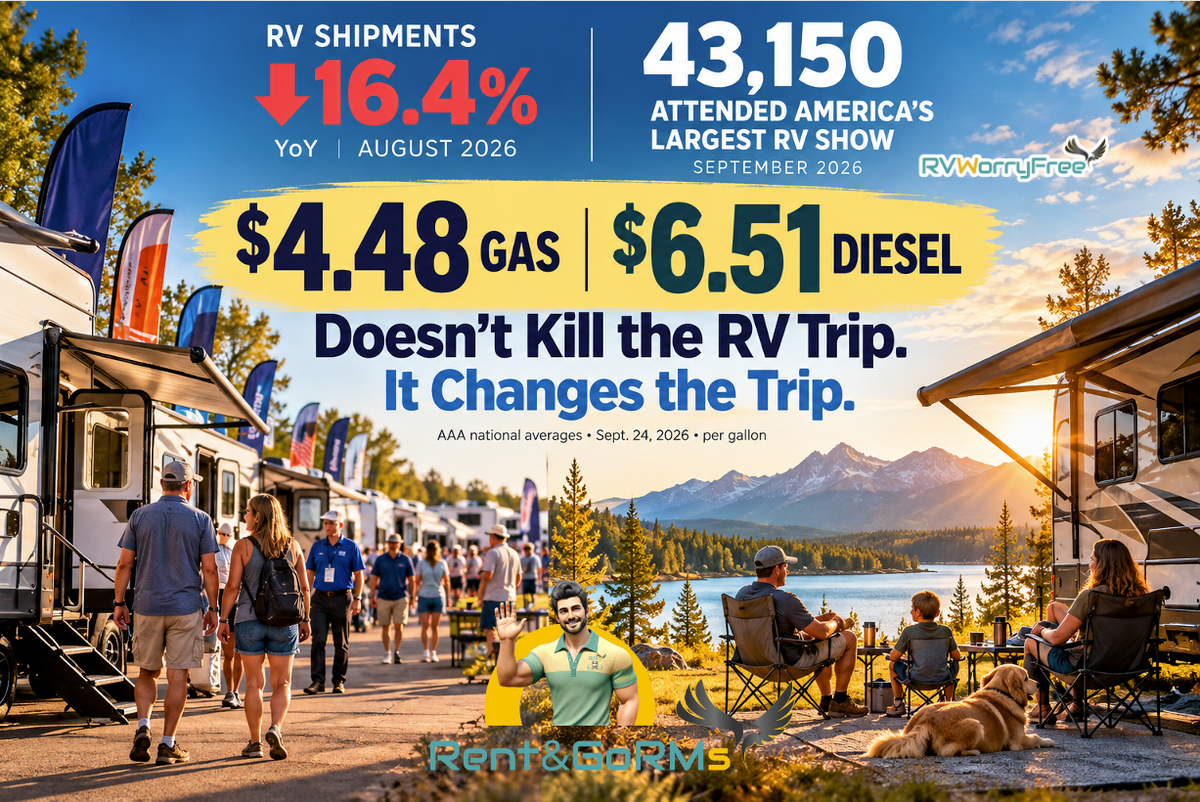
RV shipments fell 16.4% in August, yet more than 43,000 consumers still came to America's Largest RV Show. The opportunity for dealers and manufacturers may be creating another transaction between consumer interest and RV ownership.
The RV Industry May Not Have a Demand Problem. It Has a Conversion Problem.
RV shipments fell 16.4% in August while consumer interest in RVing remains substantial. See why RV dealers, rental managers and manufacturers should consider professional RV rental as a customer-conversion, fleet-utilization and revenue strategy.
For much of the RV industry's history, consumer interest and consumer conversion were treated almost as the same thing. Get people excited about RVing, bring them to the dealership, put them inside the product, arrange financing, and sell the RV.
The newest data suggests those two things are separating.
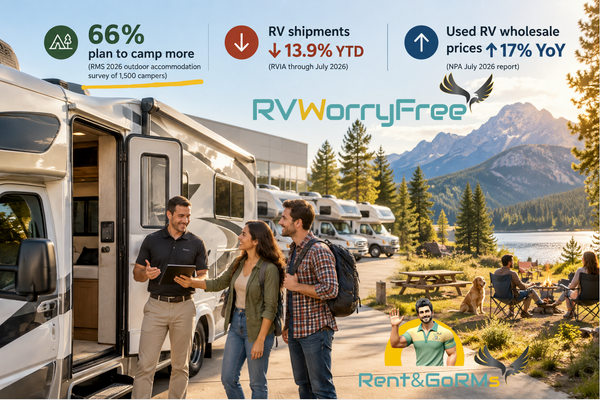
The RV Industry Association reported 23,599 wholesale RV shipments in August, down 16.4% from August 2025. Through August, shipments were down 14.2% year over year. Towables were particularly weak, declining 17.0% for the month and 16.2% year to date. RVIA
Meanwhile, 43,150 consumers attended America's Largest RV Show in Hershey, Pennsylvania, September 16–20. Attendance was lower than last year, with weather affecting the final day, but the show's organizer reported that manufacturers, dealers and vendors still saw good traffic and sales. More than 1,400 RVs from 42 manufacturers were on display. Largest RV Show
Those statistics should not be interpreted as proof that RV demand is booming. They are measuring different things.
But together they raise an important question:
What if the consumer hasn't disappeared? What if the transaction has simply become harder?
The Affordability Problem Is Now Visible at the Manufacturer Level
The latest results from THOR Industries make the pressure difficult to ignore.
For its fiscal fourth quarter, THOR reported net sales of $2.31 billion, down 8.4% year over year, while net income fell 67.5% to $40.8 million. Its North American towable RV segment reported quarterly unit shipments down 19.7%.
THOR CEO Bob Martin pointed directly to the problem: interest rates, elevated fuel costs and inflationary pressure strained household budgets and kept the North American retail market soft through the critical selling season. THOR also reported that global independent dealer inventory was down 11.5% year over year at July 31. Thor Industries
That matters because it challenges an overly simple explanation for today's RV market.
The industry cannot assume that fewer RV sales mean fewer people want to camp, travel or experience the RV lifestyle.
Some consumers may simply be unwilling or unable to make the ownership commitment under today's economics.
For an RV dealership owner or manufacturer, losing that consumer entirely should not be the only alternative to selling them an RV.
Forest River Just Gave the Industry an Important Clue
On September 24, Forest River and Octane announced Forest River Finance powered by Octane, a manufacturer-backed retail finance program.
The significance goes beyond financing.
Forest River is moving further into the infrastructure surrounding the dealer transaction in an effort to make purchasing easier and create additional value across its dealer network. Octane
That does not mean Forest River has announced a manufacturer-backed rental strategy. It has not.
But it raises a useful strategic question for every RV manufacturer:
If an OEM can build financial infrastructure to help a dealer convert a customer who is ready to buy, what infrastructure should exist for the customer who wants the experience but isn't ready to buy yet?
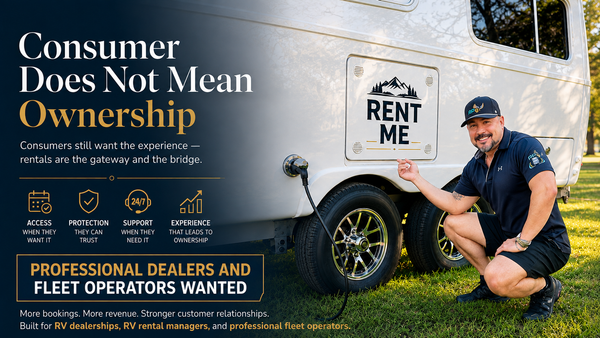
Professional RV rental is one possible answer.
Rental Creates a Transaction Where There Otherwise May Be None
Consider the consumer who walks through an RV at a dealership or RV show and loves the product.
Then the monthly payment becomes real.
Insurance becomes real. Storage becomes real. Maintenance becomes real. Interest rates become real. And now gasoline is averaging roughly $4.48 per gallon nationally, the highest AAA has recorded for this time of year. AAA Newsroom
That customer may still want to go RVing.
They simply may not want to own the asset today.
A professional RV rental program allows the dealer to say something very different from “come back when you're ready.”
Take one this weekend.
That changes the economics of the relationship.
The customer gets an experience. The dealership generates rental revenue. The asset produces income. The customer enters the dealership's ecosystem. And the dealer earns another opportunity to convert that customer later.
Rental therefore does not have to compete with retail.
It can sit between interest and ownership.
The Rental Fleet Can Become a Customer-Acquisition Engine
Dealers already spend substantial amounts acquiring prospective buyers through paid search, social advertising, RV shows, third-party leads and traditional marketing.
An RV rental fleet creates a different kind of lead.
The customer does not spend 20 minutes touring an RV. They may spend three, four or seven days living in it.
They drive it. Sleep in it. Cook in it. Connect it at a campground. Discover which features matter to their family and which ones do not.
That is a far deeper product demonstration than most traditional retail experiences can provide.
It would be unsupported to claim that every renter—or even a known percentage of renters—will eventually become an RV buyer without reliable conversion data.
But strategically, a renter can become a highly educated future prospect.
That gives an RV dealership rental department a role beyond producing rental income. It can become part of the dealership's customer-acquisition and lifecycle strategy.
Dealers Should Measure Revenue per Asset, Not Only Inventory Turn
The traditional dealership question is:
How quickly did the RV sell?
A rental operation introduces another one:
What did the RV earn while we owned it?
An RV that sits for 120 days waiting for a buyer is inventory.
A suitable unit that generates RV rental bookings during part of that period can potentially produce base rental revenue, delivery fees, mileage charges, generator usage, pet fees, protection-plan revenue and other ancillary income before eventual disposition.
That is not appropriate for every unit. Rental introduces mileage, depreciation, cleaning, maintenance, insurance, operational complexity and potential damage. Those costs must be measured against the revenue.
But that is exactly why RV fleet management matters.
A professional RV fleet manager should understand revenue per available rental day, utilization, maintenance cost, depreciation, claims frequency, ancillary revenue and eventual resale performance.
The important metric is not simply whether the RV rented.
It is whether rental improved the total economic return on the asset.
Rental Cannot Scale on a Dealership's Old Processes
There is also an operational reality the industry should not ignore.
A dealership cannot simply put ten RVs into rental inventory and expect the economics to work if every reservation requires phone calls, paper agreements, manual payments, disconnected inspections and staff-intensive check-in and checkout.
That is where RV rental software and RV rental management software become important.
Professional RV rental operations require inventory availability, booking, payments, digital agreements, customer verification, check-in and checkout, condition documentation, protection products, insurance workflows, delivery, maintenance, customer communication, claims and reporting to function as one operating system.
For the RV rental manager, technology reduces the labor required per transaction.
For the RV dealership manager, it creates visibility into the fleet.
For the RV dealership owner, it provides the data necessary to determine whether the rental business is actually improving asset economics.
Without those systems, rental can become another operational burden.
With them, it can become an additional revenue channel.
Manufacturers Should Think Beyond the First Sale
This may be the larger opportunity.
Manufacturers traditionally measure success when a unit moves through the dealer network and ultimately reaches an owner.
But the customer journey may no longer begin with ownership.
A manufacturer-backed rental strategy could potentially place selected new inventory into professional dealership rental fleets, exposing consumers to specific brands and floorplans before those consumers are ready to purchase.
After a defined period, those units could move into used or certified pre-owned inventory, creating another potential retail transaction.
That creates a possible lifecycle:
New inventory → rental fleet → rental revenue → service and maintenance → customer exposure → pre-owned inventory → eventual retail sale.
That model still needs rigorous economics. Mileage, residual value, utilization, financing, insurance and maintenance all matter.
But it deserves serious evaluation precisely because the industry's existing conversion model is under pressure.
High Fuel Prices Make the Customer Journey Even More Important
AAA reported a national average of $4.48 per gallon on September 24, more than $1.30 higher than a year earlier and the highest national average ever recorded for this time of year. Yet EIA data cited by AAA showed gasoline demand actually increased slightly during the preceding week. AAA Newsroom
That is another useful warning against oversimplification.
High gasoline prices do not automatically mean consumers stop traveling.
They may change how far they travel, how long they stay, what they rent and how carefully they evaluate the total cost of the trip.
For an RV rental company owner or RV fleet manager, that may increase the importance of shorter regional rentals, delivery to campgrounds, transparent trip pricing and efficient fleet utilization.
Again, that is a strategic inference—not a measured causal relationship—but it is one professional RV rental operators should be testing in their own booking data.
The Opportunity Is Larger Than RV
The same issue exists across other expensive, intermittently used assets.
Boats, motorcycles, side-by-sides, ATVs, trailers and specialty vehicles all require meaningful upfront capital while often spending substantial periods unused.
The automotive industry has spent decades developing leasing, rental and other access models around the same fundamental consumer tension.
Ownership and access do not have to be opposing business models.
One can lead to the other.
That makes the broader opportunity for motorized fleet operators increasingly interesting: use access to generate revenue from the asset today while preserving the opportunity for ownership tomorrow.
Stop Treating “Didn't Buy” as the End of the Customer Journey
The August shipment data is real.
So are THOR's results.
So are the tens of thousands of consumers who walked through RVs at Hershey.
None of those statistics proves that rental will solve the industry's retail challenges.
But together they point toward a weakness in the traditional model.
The industry has spent decades optimizing the transaction for the customer who is ready to buy.
It has done far less to monetize the customer who says:
“I love this. I'm just not ready to own it.”
That customer should not disappear.
Let them rent it.
Let them experience it.
Generate revenue from the asset.
Keep the relationship.
Learn what they want.
And when the customer is ready to own, make sure the dealership that introduced them to the lifestyle is still there.
The RV industry may not have an interest problem.
It may have a missing transaction.
And professional rental could be that transaction.