The Message From Elkhart Was Caution. The Opportunity May Be Utilization.


Dealers and manufacturers left the 2026 Elkhart Open House facing another challenging retail environment. But if consumers still want RV experiences, the next growth opportunity may be less about moving inventory faster—and more about making each asset work harder.
Elkhart RV Open House 2026: Why RV Dealers Should Focus on Fleet Utilization, Rental Revenue and Customer Conversion
The 2026 Elkhart RV Open House showed cautious optimism amid a soft retail market. New data on RV shipments, pre-owned values, fuel costs and camping demand makes the case for RV rental fleets, asset utilization and new customer-conversion strategies.
The 2026 Elkhart RV Open House did not feel like an industry preparing for explosive growth.
It felt like an industry preparing to operate smarter.
Thousands of 2027 model-year RVs were on display across Elkhart and Goshen as dealers gathered with THOR Industries, Forest River, Coachmen and manufacturers from across the market. RVBusiness described the overall tone as “somewhat optimistic” in the face of a challenging market, while several executives said traffic appeared somewhat lighter than in prior years. Dealers and manufacturers were largely focused on three things: the difficult retail environment, the Open House itself, and how cautiously OEMs are approaching 2027 product. RVBusiness - Breaking RV Industry News
That caution makes sense.
New-RV economics remain difficult. Fuel costs remain historically high. Consumer budgets are stretched. And manufacturers are increasingly looking for ways to help dealers create value beyond simply putting more inventory on the ground.
But one thing was also apparent in Elkhart: the industry is not standing still.
The strategic question now is whether dealerships and manufacturers should continue measuring success primarily by how quickly an RV sells—or begin asking what that asset can earn, who it can introduce to the brand, and how many transactions it can create throughout its lifecycle.
That is where professional rental deserves a much larger place in the conversation.
The Market Is Telling Dealers to Be Careful
The industry's caution is supported by the numbers.
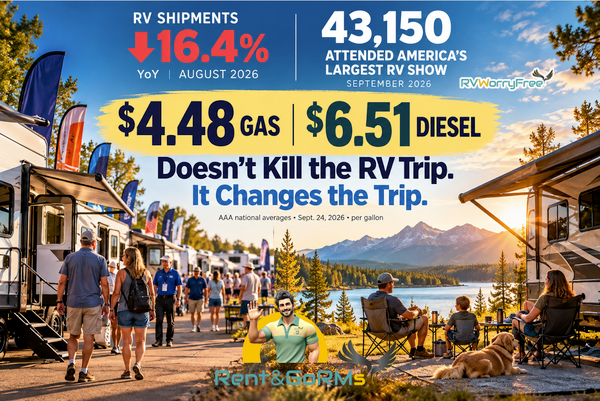
RV Industry Association data showed August wholesale shipments down 16.4% year over year, continuing a difficult 2026 for new-unit volume.
At Elkhart, some OEM and dealer executives openly suggested the industry should be prepared for 2027 to look similar to 2026, rather than expecting an immediate return to aggressive growth. RVBusiness also reported that many manufacturers elected to play it safe with 2027 models rather than commit to expensive wholesale product changes. RVBusiness - Breaking RV Industry News
That does not mean the industry is contracting permanently.
It means capital discipline matters.
Inventory discipline matters.
And for an RV dealership owner or RV dealership manager, the economics of every unit on the lot matter more.
If a unit sits idle, the carrying costs remain.
Financing remains.
Insurance remains.
Depreciation remains.
Storage remains.
Maintenance remains.
The most important question may therefore be shifting from:
How quickly can we sell this RV?
to:
What can this RV earn while we own it?
This Week’s Used-RV Data Makes That Question Even More Relevant
The latest pre-owned market data strengthens the argument.
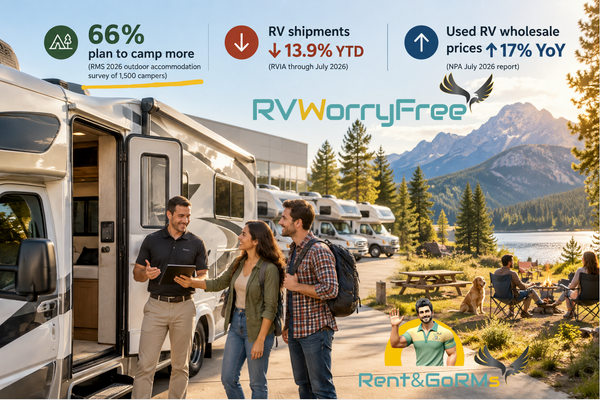
National Powersport Auctions reported this week that RV and camper average wholesale prices are running 23% above year-ago levels, even as seasonal pricing begins to cool. NPA characterized pre-owned RVs as a relative bright spot and said more shoppers are seeking value rather than making the larger financial commitment required for a new unit. RVBusiness - Breaking RV Industry News
That distinction is strategically important.
A healthy used market gives an RV dealer more potential options for an asset than simply:
Buy new → wait → retail new.
A professionally managed unit could potentially move through a broader lifecycle:
New inventory → rental fleet → rental revenue → service and maintenance → eventual pre-owned sale.
That does not automatically mean every new RV should become rental inventory. It should not.
Mileage, wear, insurance, claims exposure, maintenance and residual value must all be measured.
But when properly selected and managed, rental creates something traditional inventory does not:
revenue before disposition.
For an RV fleet manager or RV rental company owner, this is standard thinking.
For many dealerships, it remains an underused strategy.
Elkhart Also Showed the Importance of the Dealer Relationship
The Open House itself remains fundamentally a dealer event.
Forest River's 17th Annual Product Expo ran September 28 through October 1 and positioned its message around partnership with dealers and helping them grow their businesses. THOR's Dealer Open House ran September 28–30 at the RV/MH Hall of Fame. The accompanying supplier showcase included 141 companies from North America and overseas, emphasizing just how broad the ecosystem supporting dealerships has become. Forest River
And while public trade coverage did not identify rental as one of the headline themes of the Open House, our conversations in Elkhart repeatedly returned to it.
We discussed dealer-backed rental programs.
We discussed manufacturers placing selected inventory into rental fleets.
We discussed customers experiencing an RV before committing to ownership.
We discussed using rentals to improve dealer economics while building a new customer pipeline.
And we discussed what happens when an RV comes out of fleet service and becomes a well-maintained, documented pre-owned unit.
Those discussions are not yet proof of an industry-wide shift.
But they are evidence that some dealers and OEM leaders are beginning to ask a different set of questions.
Rental Can Solve More Than One Problem at Once
Professional RV rental is often treated as a standalone business.
That framing is too narrow.
A dealership rental department can potentially address several dealer challenges simultaneously.
It can create RV rental revenue from an asset before resale.
It can increase fleet utilization.
It can create opportunities for protection products, delivery, convenience products and ancillary revenue.
It can introduce new customers to the dealership.
It can let those customers try different RV types and floorplans.
It can create future pre-owned inventory with known service history.
And it can create another pathway toward eventual ownership.
For an RV rental manager, that is rental management.
For a dealership owner, it can be a customer-lifecycle strategy.
That difference matters.
Consumers Still Want to RV
The strongest argument against giving up on the consumer is that the desire to travel has not disappeared.
RVIA's fall travel research found 23 million Americans plan to take an RV trip this fall, including more than 9.4 million people who do not currently own an RV and expect to rent or borrow one. RVIA
Those numbers are not Open House data, but they provide context for what dealers are facing.
The consumer may still want the lifestyle.
The harder question is whether they want—or can afford—the ownership commitment today.
That creates a gap between interest and ownership.
Rental can occupy that gap.
Instead of telling a customer who is not ready to buy to come back in a year, an RV dealership rental department can say:
Take one this weekend.
That turns lost purchase intent into an immediate transaction.
And it keeps the customer inside the dealership's ecosystem.
Fuel Prices Reinforce the Need to Rethink the Trip
Travel economics are also changing.
AAA reported on October 1 that the national average for regular gasoline had fallen slightly to $4.41 per gallon, but September still set a record monthly average at $4.33, well above the prior September record. AAA Newsroom
High fuel prices do not necessarily eliminate RV travel.
They can change the trip.
Consumers may drive fewer miles.
Stay closer to home.
Choose a smaller motorized unit.
Use campground delivery.
Or take more three- and four-night regional trips instead of a cross-country vacation.
For an RV rental manager or RV fleet manager, that changes how inventory should be priced and marketed.
A regional weekend package may become more relevant than the traditional long-distance rental.
Delivery may become more valuable.
Transparent total-trip pricing becomes more important.
And shorter-duration rentals place even more pressure on operators to make the booking and turnaround process efficient.
That Is Where RV Rental Software Becomes Part of the Economics
Shorter rentals only work if the operation is efficient.
A dealer cannot scale a professional rental fleet by managing every booking through phone calls, spreadsheets, printed agreements and disconnected inspections.
Modern RV rental software and RV rental management software should help an operator manage availability, pricing, payments, agreements, renter verification, check-in, checkout, condition reporting, delivery, protection products, roadside support, claims documentation, maintenance and reporting.
The objective is not simply convenience.
It is reducing the cost and labor required per rental transaction.
That is what makes a three-night rental economically viable.
And it gives the RV dealership manager or owner something even more important: visibility into whether the fleet is actually producing an acceptable return.
The Next Step Is Revenue Management, Not Just Rental Management
Another trend emerging outside the dealership provides a useful clue.
Campground technology provider Campspot recently introduced an expanded revenue-management system that analyzes booking pace, year-over-year results and current demand to help operators optimize pricing.
Campgrounds are increasingly thinking like hotels and airlines.
The RV rental industry should eventually do the same.
A professional RV rental fleet should not simply ask:
What is our daily rate?
It should ask:
What is this unit worth on this date, in this market, based on demand, availability, trip length and remaining fleet capacity?
That is the next level of RV fleet management.
And it becomes particularly powerful when a dealership combines rental operations with maintenance records, customer data and eventual resale performance.
Elkhart’s Real Message May Have Been Bigger Than Product
The 2026 Open House showcased thousands of new models, new floorplans and new technology.
But the more important message may have been economic.
Dealers are being asked to succeed in a market where consumers remain interested but cautious.
Manufacturers are being asked to support those dealers more directly.
And every asset needs to work harder.
Rental will not solve every problem facing the RV industry.
It will not make every customer a future buyer.
And not every dealership should immediately launch a rental fleet.
But it deserves to be evaluated as something much larger than a side department.
For the right dealer, it can be:
a utilization strategy,
a revenue strategy,
a customer-acquisition strategy,
a pre-owned inventory strategy,
and potentially an ownership-conversion strategy.
That is why the conversations happening now matter.
The next era of RV retail may not be built entirely around selling more units faster.
It may also be about generating more economic value from each unit—and creating more ways for consumers to enter the RV lifestyle.
The message from Elkhart was caution.
The opportunity may be utilization.
Eo Sparks *Founder